Measure the awkward bit first
A published folded size describes a package, not your ability to manoeuvre it. Measure the narrowest opening, the turn behind the door and the space available while the door swings. Include protruding pedals, handlebars and accessories in your comparison. A vehicle that fits a cupboard on paper may be impossible to turn into that cupboard without lifting it above waist height.
Trace the whole storage route with your ordinary bag in hand. Notice whether you need a free hand for keys, a heavy door or a stair rail. Check whether the floor is level and whether a folded vehicle remains stable without someone holding it. Storage that depends on balancing equipment against an escape door is not an acceptable solution.
Distinguish carrying from rolling
Folding products use different strategies. Brompton packages its components around a compact fold; STRiDA uses a distinctive frame and folding arrangement; Tern Vektron combines folding with electric assistance. These are useful starting points for comparison, not proof that one is easiest for everyone. Model year, accessories and battery choice can alter what you actually handle.
Try the exact carrying grip with permission and supervision. Do not judge only the first lift. Consider a pause on a landing, setting the vehicle down without trapping fingers and picking it up again while tired. Rolling a folded machine can reduce lifting but needs suitable wheels, clearance and an approved handling position. Dragging a component not designed for the task can damage the vehicle or create a trip hazard.
Give parking its own plan
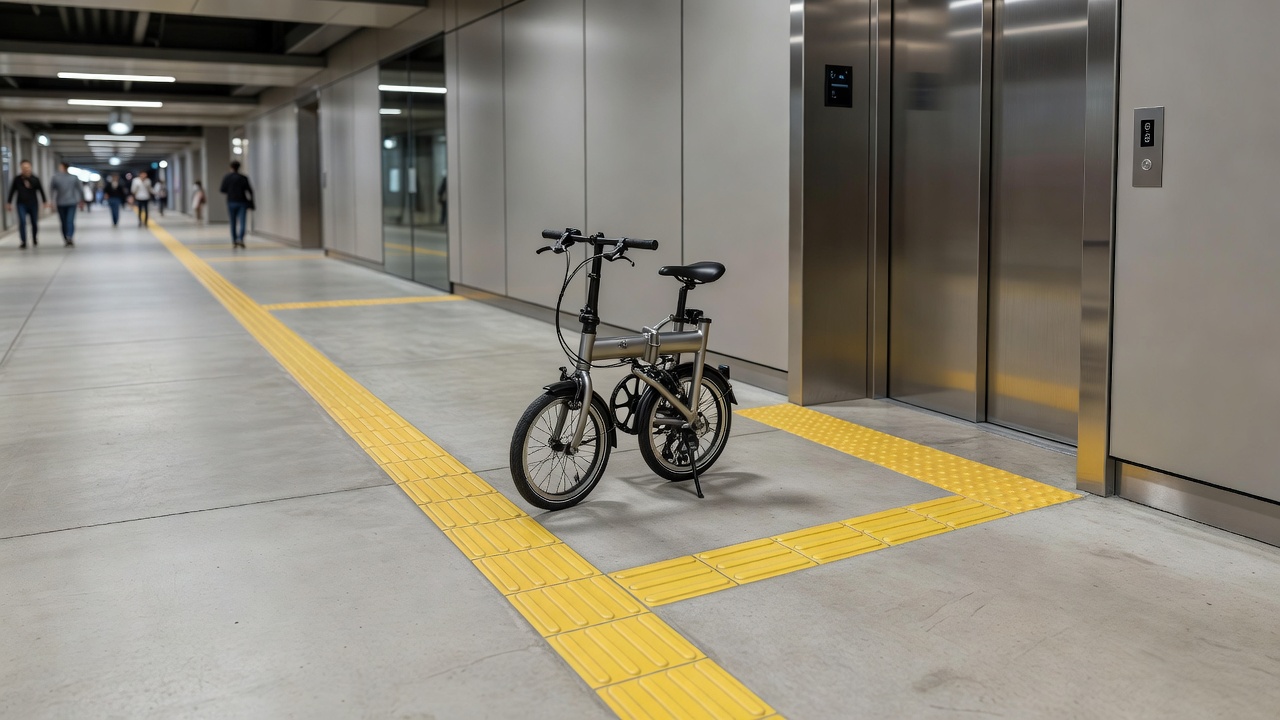
A small footprint does not remove the need for secure, permitted parking. Identify a suitable fixed anchor and use a locking method appropriate to the vehicle and the manufacturer’s instructions. Avoid obstructing access, tactile paving, handrails or dropped kerbs. If a building offers storage, ask whether powered vehicles and removable batteries are covered by its policy.
Outdoor parking adds exposure to rain, dirt and theft. Indoor parking brings different issues: wet tyres, protruding parts and the possibility that a folded vehicle unfolds or tips. Ask whether the machine can be stored in the intended orientation. Do not assume every electric vehicle may be placed vertically or laid on its side simply because a promotional image looks tidy.
Check the connection before the commute
Train and bus policies are part of the route design. Transport for London and Ruter publish passenger conditions, but those conditions should not be generalised to every operator or vehicle type. A policy for folded bicycles may not cover an electric scooter, a compact seated device or a damaged battery. Restrictions can also differ between services, stations and times.
Look for the named vehicle category, maximum package requirements, battery restrictions and any requirement to keep equipment covered or secured. Check station access separately: an accepted vehicle can still be awkward to move through a station with stairs or a temporary lift closure. Have a route that does not depend on staff carrying your equipment.
Plan charging without creating an obstacle
Use the manufacturer-specified charger and follow the battery instructions. Keep charging away from escape routes and unsuitable surfaces, and follow building and fire-safety requirements. Do not use a visibly damaged battery or charger. Unusual heat, swelling, damage or signs of water ingress require the manufacturer’s advice rather than an improvised repair.
A removable battery can change the carrying task, but it creates another object to handle and store. Confirm the approved removal process, connector protection and charging conditions. Do not charge unattended or while asleep. If you cannot identify an appropriate charging place, treat that as a failed journey requirement rather than a detail to solve after purchase.
Compare evidence you can use
| Task | Useful evidence | Not enough on its own |
|---|---|---|
| Folding | Exact model manual and supervised demonstration | A fast edited video |
| Carrying | Configured weight, grip and personal trial | A frame-only weight |
| Public transport | Current operator conditions for that category | Someone else’s journey photo |
| Charging | Approved charger and battery instructions | A compatible-looking plug |
Source basis: the manufacturer and operator documents linked below. No independent product measurements are claimed.
Finally, repeat the assessment with the vehicle dirty, your coat on and a delivery waiting at the door. You do not need to stage unsafe conditions; simply ask which tasks become harder. The concept that works when you are tired, loaded and short of space is more useful than the one that only looks effortless in an empty room.